September 30, 2026
Why do I even care about building an embroidery SaaS?
I got into computer graphics during my Master’s at ETH. I loved the field because it was perfectly merging scientific and technical skills. To do computer graphics, you need to know how to code, and you need to know math. You can really leverage any kind of math within computer graphics, that’s quite amazing! The cherry on top is that the end result wasn’t just a bland terminal response, but beautiful images or animations. I quickly fell in love with the field. And the subfield that drew me into my PhD was shape modeling and digital geometry.
What I quickly realized during my PhD is that I love creating tools that can help people be more creative. This has been the foundational motivation behind my work: how can I create shape representations and methods that would make the act of creation faster and more accessible? How can I help MORE people to create MORE? This has become my life quest, or, as it is often named in the now-mainstream self-help jargon, my Ikigai. I started with 2D curves, then went into 3D with a sketch-based shape creation method and a tetrahedral representation for mesh optimization. But there is another line of work that changed everything: the use of semantic-driven optimization to create geometry. Or in other words: using AI models (in our case via distillation) to help create shapes by capturing the intent of the user with an input text or image.
There is a lot of discourse about whether we’ll need geometry in the future, especially because we can now generate frames. Has geometry now been relegated to the rank of irrelevant “fake tasks”? A thing of the past that we don’t really need anymore to create videos or games? I don’t know. But what I know is that geometric structure is a clear end goal when it comes to fabrication. Basically, when we step out of the digital world, we surely need the structure that geometry brings to the table.
And in my work on the creation of 2D geometry, machine embroidery was always an interesting (and super beautiful!) fabrication application. When you have geometric information, you can then map it to a list of instructions that an embroidery machine can use to recreate it on fabric. How does that work? Fundamentally, you need to put stitches so that the thread between two stitches covers the shape you intend to create. It’s as if you were “painting with threads”.
You do have algorithms that can take, say, a filled shape and compute the path that the machine needs to take to fill it with thread. But it’s not that simple. You do have some constraints that typical purely digital media don’t care about: what if you have several layers on top of each other? What if you have gradients? What if the design has hundreds of different colors, which translates into hundreds of thread changes? How do you optimize the design so that you decrease the number of jumps and trims (which take a lot of time at the machine if you don’t care about them, on top of increasing the risk of thread breaks)? And taking into account density, push/pull compensation, and the different material properties of the fabric being used makes it a non-trivial task.
Ultimately, typical vector graphics do not even capture what embroidery can do. A thread has an anisotropic sheen, which means that you can see the direction of an embroidery filling. It also has a width. On a screen, a line over the same line renders the same. But in the world of embroidery, stitching on top of each other marks the line more as a dashed line (this is what bean stitches do, notably). Embroidery is not a mere discretization of flat geometry! It is way more akin to the discretization of vector fields. The best embroidery designs do have a “flow”, and like paintings, they can be extremely realistic despite the necessary color quantization imposed by the choice of thread colors.
A quick glance at the state of the industry makes you realize that there is a massive opportunity. Current embroidery software is rather complex and old-looking. Good software not only needs to provide the tools for creating shapes with an intuitive UI, but like any CAD software, it needs to properly map the intent of the creator to a design that can be fabricated in the real world. It is a very slow process, even for good digitizers, and a real bottleneck for many embroidery shops. On top of that, many people who do embroidery as a recreational activity are not experts in digital design and simply do not believe they can learn how to do it.
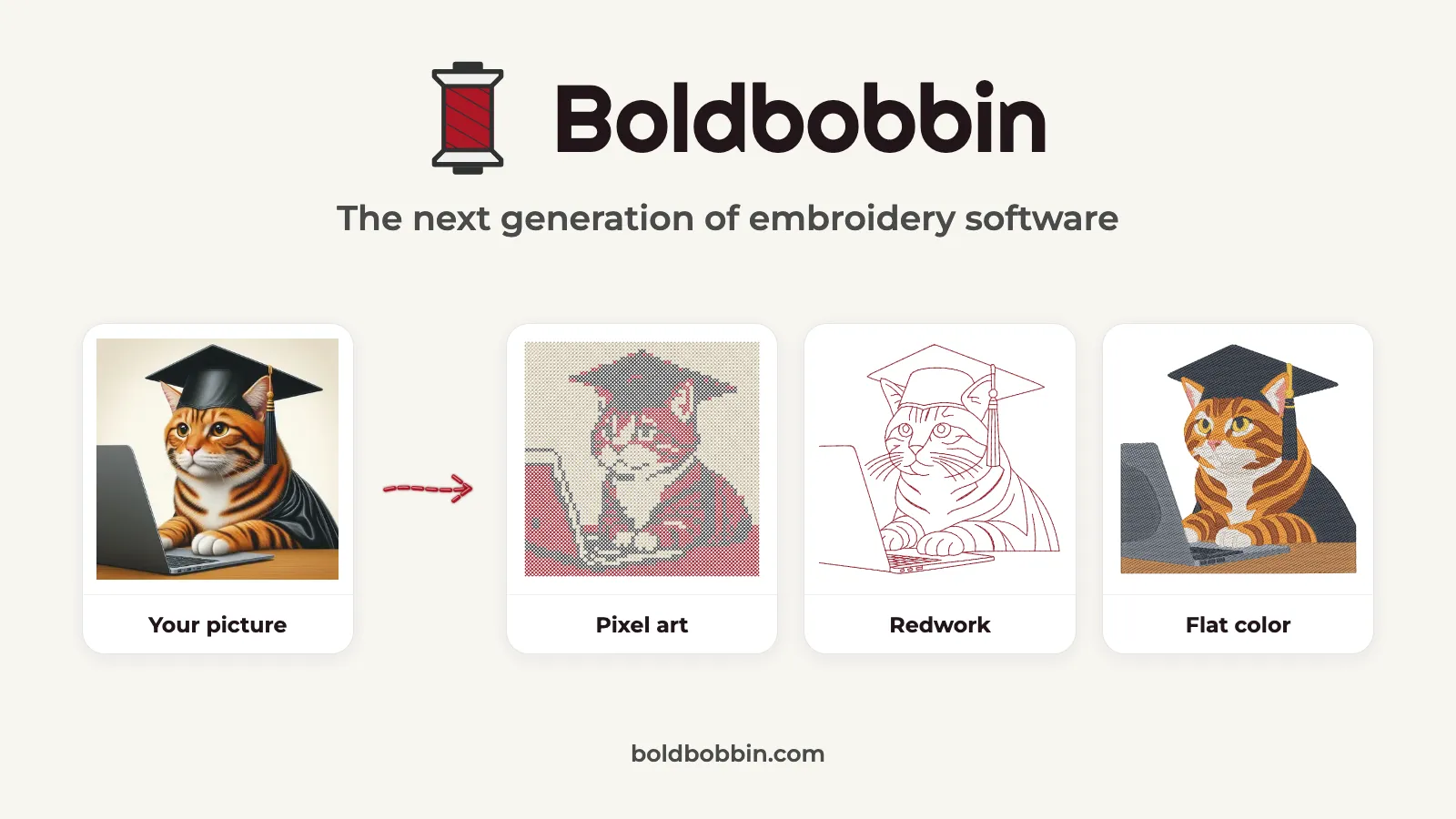
With Boldbobbin, I’m developing methods that can leverage AI pipelines for this under-served industry. Methods that map the intention of the user to a finished design help two categories of people: the ones who need faster design creation to serve more clients, and the ones who can’t use current software because they lack the skills, or the confidence and time to learn them.
Boldbobbin is the next gen of embroidery software. Built for speed, ease of use, quality and inclusivity. Hopefully, I gave you the desire to follow how its story will unfold 😉